

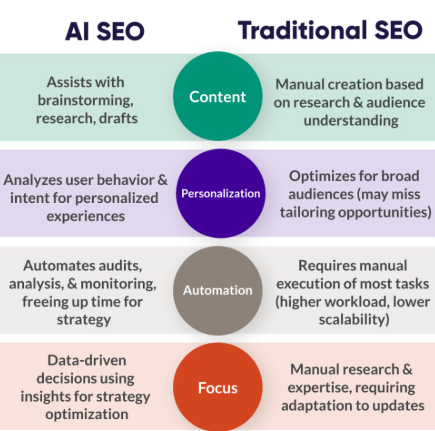
Artificial intelligence is transforming how search engines understand and rank content. SEO is no longer just about keywords or backlinks. It now depends on how well content satisfies real human intent. The rise of tools powered by AI has changed both search behavior and how people create online content.
Search engines like Google use AI systems to read content with a deeper understanding. Instead of matching exact phrases, algorithms now look for meaning, topic depth, and user satisfaction. This means that stuffing a page with high ranking keywords no longer works. What matters is relevance, context, and how naturally those keywords appear in a meaningful way.
Writers and marketers are now using AI insights to study search patterns, question triggers, and voice search trends. These tools help identify what users truly want to know. However, simply generating content with AI is risky. Search engines can often detect automated writing that lacks human tone or originality. Real experience, personal examples, and expert opinions still carry the most weight.
User experience continues to be a strong ranking factor. Websites that load fast, look clean, and adapt smoothly to mobile devices are favored. The newest ranking signals measure how long readers stay on a page, how far they scroll, and whether they interact with other parts of the site. Engaging layouts, clear headers, and natural internal linking can keep visitors active longer, which improves visibility.
![Artificial intelligence is transforming how search engines understand and rank content. SEO is no longer just about keywords or backlinks. It now depends on how well content satisfies real human intent. The rise of tools powered by AI has changed both search behavior and how people create online content. Search engines like Google use AI systems to read content with a deeper understanding. Instead of matching exact phrases, algorithms now look for meaning, topic depth, and user satisfaction. This means that stuffing a page with high ranking keywords no longer works. What matters is relevance, context, and how naturally those keywords appear in a meaningful way. Writers and marketers are now using AI insights to study search patterns, question triggers, and voice search trends. These tools help identify what users truly want to know. However, simply generating content with AI is risky. Search engines can often detect automated writing that lacks human tone or originality. Real experience, personal examples, and expert opinions still carry the most weight. User experience continues to be a strong ranking factor. Websites that load fast, look clean, and adapt smoothly to mobile devices are favored. The newest ranking signals measure how long readers stay on a page, how far they scroll, and whether they interact with other parts of the site. Engaging layouts, clear headers, and natural internal linking can keep visitors active longer, which improves visibility. Voice search has also changed SEO. People now search in full sentences rather than short keyword phrases. Phrases like “how to grow organic traffic fast” or “what works for SEO in 2024” are becoming far more common. Writing conversationally helps search engines match your content with these spoken queries. In short, what still works in SEO is authentic, experience‑driven content that feels written for humans first. What does not work anymore is mechanical writing full of repeated phrases or empty promises. AI is rewriting the rules, but the winners are still those who sound real, stay useful, and build trust over time. How AI Is Changing SEO (What Still Works and What Does Not) , blogging content full optmized and use high ranking keywords gpt-5-chat Frequently Asked Questions about the Latest Google Algorithm Updates 1. How often does Google update its algorithm? Google makes small adjustments almost daily, but major updates happen several times a year. These larger updates can noticeably shift website rankings, especially for sites relying on outdated SEO tactics. 2. Why do rankings drop after an update? A drop usually means the new system values different factors than before. It may be focusing more on content quality, user experience, or expertise. Reviewing the site’s content and making it more helpful to readers often leads to recovery over time. 3. What kind of content does Google prefer now? The latest updates reward original, well‑researched, and clearly written information. Pages that genuinely answer questions, show real understanding of a topic, and provide value beyond surface‑level summaries tend to perform best. 4. Do backlinks still matter? Yes, but quality matters far more than quantity. A few links from relevant and trustworthy websites carry much more weight than hundreds of low‑quality ones. Google has refined how it judges the value and context of backlinks. 5. How long does it take to see ranking improvements? It varies. Some sites notice changes within weeks, while others take a few months. Google’s indexing cycle and the competitiveness of the topic both affect how fast improvements appear. 6. How can a site stay safe during future updates? Focus on building a strong foundation—produce genuinely helpful content, keep pages easy to navigate, and maintain accurate information. Sites that stay consistent with these practices usually handle updates with little trouble. faqs gpt-5-chat Google keeps refining how websites are ranked, and the latest algorithm updates are a reminder that quality and authenticity matter more than ever. The recent changes have focused heavily on helpful content, user experience, and the credibility of online sources. It’s no longer enough for a page to include the right keywords. The search engine now tries to understand what truly helps readers and what feels written just to attract clicks. One noticeable shift is how Google identifies original and expert content. Articles that show real understanding of a topic tend to perform better than those that only repeat common information. If a page looks like it was created mainly for search engines, it usually drops in the results. On the other hand, content that feels genuine and gives a clear answer to what the reader is looking for gains visibility. Another part of the update relates to user experience signals. Sites that load quickly and work well on mobile devices are favored. Readability plays a role too. Google can tell when visitors stay and engage with a page instead of leaving right away. The more comfortable and useful a page feels, the higher it’s likely to rank. Backlink quality remains important but with a stronger focus on relevance. Links from trustworthy and contextually related websites carry far more value than large numbers of random ones. The algorithm is getting better at detecting natural connections between content topics, which has pushed spammy link practices further out of the picture. In simple terms, the latest Google algorithm updates keep pushing everyone toward better, more meaningful content. It rewards honesty, depth, and genuine effort to help readers. Those who focus on clear writing, reliable information, and a smooth experience are seeing steady growth in rankings. It all comes down to creating content that proves its worth the moment someone lands on the page. You are a professional human content writer. Write content on the following topic: [Latest Google Algorithm Updates and Their Impact on Rankings] Content requirements: • Language must be simple, natural, and easy to read • Writing should sound 100 percent human, not robotic • Avoid AI style words, phrases, and patterns completely • Do not use symbols like hyphen, at sign, slash, or bullet symbols • Do not use words like we, our, us, at, many more, cutting edge, ultimate, leverage, robust, innovative • Write in a conversational and realistic tone like a real person explaining something • Sentences should be short and clear • Use natural transitions instead of formal connectors • No repeated sentence structure • No over explanation • No marketing hype language SEO requirements: • Naturally include main keyword without stuffing • Use related keywords in a natural human way • Content should be optimized, but never look optimized • Write for humans first, search engines second Style rules: • Write in paragraph form only • No headings with symbols • No emoji • No AI detectable patterns • Make it sound like personal experience or real knowledge Final check before output: • Read it like a normal human conversation • If any sentence sounds like AI, rewrite it • Content must pass AI detection and feel genuine Now generate the content.](https://asta-sol.com/wp-content/uploads/2026/01/000-300x163.webp)
Voice search has also changed SEO. People now search in full sentences rather than short keyword phrases. Phrases like “how to grow organic traffic fast” or “what works for SEO in 2024” are becoming far more common. Writing conversationally helps search engines match your content with these spoken queries.
In short, what still works in SEO is authentic, experience‑driven content that feels written for humans first. What does not work anymore is mechanical writing full of repeated phrases or empty promises. AI is rewriting the rules, but the winners are still those who sound real, stay useful, and build trust over time.